Showing posts sorted by relevance for query Father. Sort by date Show all posts

Sunday, July 12, 2020

EUREKA! IT NOW CONNECTS! WE ARE CHILDREN OF ABRAHAM BY VIRTUE OF OUR FAITH IN CHRIST


4 “Behold, my covenant is with you, and you shall be the father of a multitude of nations. 5 No longer shall your name be called Abram, but your name shall be Abraham, for I have made you the father of a multitude of nations. 6 I will make you exceedingly fruitful, and I will make you into nations, and kings shall come from you. (Genesis 17:4-6)

Whenever God chooses to reveal from His Word, it simply connects now! 

         I will elaborate on why Abraham was given the name change, but before that I will reinforce a point I have elaborated in an earlier blog why the hype over gematria is extra-biblical. 

         This came out fresh from my morning devotion from Genesis 17: God reinforced in me again in Genesis 17:1 that He used the word תִּשְׁעִים instead of the gematria-style numbering system which was introduced as man's creation for the number 99. 


        In other passages of the Tanakh, the numbers were never written the way gematria would have it put. You can go to the books of the Historical and Prophetic Books of the Tanakh to see how the years of the kings were recorded. God never used the Gematria numbering system even for the years. 

        Gematria was devised much later out of convenience to give the Jews a numbering system that they could use. This was subsequently adopted by Jewish scholars to assign the chapters and verses of the Tanakh to help them to find the references quickly. 


We are Children of Abraham

         In the second part of the passage, God opened my eyes to see how the name Abraham came about. Although accurate, the nuances in the original text have somehow gone missing when it was translated into English.          
 
               Here, we see God giving a new name to Abram אַבְרָם. The name Abraham is, in fact, a superimposition of two words. 

אַב־הֲמוֹן

        אַב  in Hebrew means 'father' and הֲמוֹן גּוֹיִם means 'a multitude of nations.'

         The name, אַבְרָהָם (Abraham) is, therefore, correctly translated as 'the father of a multitude of nations.' In the Hebrew text, the meaning of the name is clearly explained. This interpretation is consistent with the Hebrew text; in fact, it is clearly explained that the name Abraham means just that! There is nothing mystical about it or that God breathed the letter ה into Abram's name!

         God's promise to Abraham was once again given in Genesis 17. In verses 4-5, we see God promising that Abraham would be the father of a multitude of nations, not just one nation. This clearly shows the all-inclusiveness of all nations in Adonai's grand plan for mankind.
“As for Me, behold, My covenant is with you,
And you will be the father of a multitude of nations.
“No longer shall your name be called Abram,
But your name shall be Abraham;
For I have made you the father of a multitude of nations.
Saved By Grace through Faith 

            How is this possible then? 

           For us who believe in Jesus, it is made possible on account of faith, not works of the Torah. 

           We have the account of Abraham being reckoned by God as righteous because of his faith in the LORD (Genesis 15:6):
Then he believed in the LORD; and He reckoned it to him as righteousness.
         From Paul's own writing, we read in Romans 4:2-3:
εἰ γὰρ Ἀβραὰμ ἐξ ἔργων ἐδικαιώθη, ἔχει καύχημα, ἀλλ̓ οὐ πρὸς θεόν. τί γὰρ ἡ γραφὴ λέγει; ἐπίστευσεν δὲ Ἀβραὰμ τῷ θεῷ καὶ ἐλογίσθη αὐτῷ εἰς δικαιοσύνην.
For if Abraham was justified by works, he has something to boast about, but not before God. For what does the Scripture say? “ABRAHAM BELIEVED GOD, AND IT WAS CREDITED TO HIM AS RIGHTEOUSNESS.”
           As Gentiles, we are now considered the children of Abraham, sharing the same promise or co-heirs of the promise that was given to Abraham. 
And if you belong to Christ, then you are Abraham’s descendants, heirs according to promise. (Galatians 3:9). 
           Nowhere are we told to be grafted to the house of Israel or be aligned with Israel. Instead, we are told in Romans 11 that it is together with a remnant from the house of Israel, we who are the goyim (גוִיִם or other nations) are now partakers of the promises given to Abraham. 

          We are culturally distinct from Israel because we are not descendants of Jacob. The descendants of Jacob adopted Jacob's new name, Israel. We are the descendants of other nations (or the goyim), not and will never be Israel. Our identities are clearly different from the Jews and God sees us not as Jews but the goyim; yet in Christ, both the remnant of Israel and us are being made one new man (Ephesians 2:14-15).

          Therefore, as the Jerusalem Council had clearly mandated (read Acts 15), we are we never told to live like the Jews or follow the Jewish rituals (its new moons, different kinds of Sabbath and the religious feasts which I have written in a number of blog posts. This is a summary of it all). In fact, I asked this very question Paul asked, "Are those who want to follow the Torah placed under a curse?"

         If we are now saved by grace through faith, and we are co-heirs of the same inheritance promised to Abraham, despite of our position as the goyim (or other nations), let us continue strive to abide in Christ.  

             Paul sums it very well in Galatians 3:16-18:
τῷ δὲ Ἀβραὰμ ἐρρέθησαν αἱ ἐπαγγελίαι καὶ τῷ σπέρματι αὐτοῦ. οὐ λέγει· καὶ τοῖς σπέρμασιν, ὡς ἐπὶ πολλῶν ἀλλ̓ ὡς ἐφ̓ ἑνός· καὶ τῷ σπέρματί σου, ὅς ἐστιν Χριστός. τοῦτο δὲ λέγω· διαθήκην προκεκυρωμένην ὑπὸ τοῦ θεοῦ ὁ μετὰ τετρακόσια καὶ τριάκοντα ἔτη γεγονὼς νόμος οὐκ ἀκυροῖ εἰς τὸ καταργῆσαι τὴν ἐπαγγελίαν. εἰ γὰρ ἐκ νόμου ἡ κληρονομία, οὐκέτι ἐξ ἐπαγγελίας· τῷ δὲ Ἀβραὰμ δἰ ἐπαγγελίας κεχάρισται ὁ θεός. (Galatians 3:16-18)
           The New American Standard Bible translates it as:
Now the promises were spoken to Abraham and to his seed. He does not say, “And to seeds,” as referring to many, but rather to one, “And to your seed,” that is, Christ. What I am saying is this: the Law, which came four hundred and thirty years later, does not invalidate a covenant previously ratified by God, so as to nullify the promise. For if the inheritance is based on law, it is no longer based on a promise; but God has granted it to Abraham by means of a promise.
          In our zest to align ourselves with God, let us not be deceived by all winds of doctrines now creeping into our churches. Some have been teaching that we need to align ourselves with the house of Israel and follow the Jewish religious practices and the Torah in order to please God. 
       
         This is the leaven of the Pharisees and the Saducees that Jesus condemned strongly and Paul opposed vehemently in many of his epistles to the Gentile churches. The Torah is no longer written on stone tablets, but the Spirit in writing it on our hearts of flesh create in us a desire to live a life that is pleasing unto the Lord. Let us therefore live by the Spirit not by the services (ἔργων νόμου, which is equivalent to the word עֲבֹדָה in Hebrew) according to the Torah. 


This section on "What about Israel?" Updated on April 13, 2025: 

What about Israel?

        And, what about Israel in God's covenant to Abraham? This has always been a puzzle to me. Would someday the whole of Israel be saved as some would claim? Or, has Israel been totally abandoned? 

        The answer is in the next few verses (Genesis 17: 7-10). While verses 4-6 of God's covenant was an inclusive part of God's plan for His church (made of both Jews and Gentiles), the next few verses refer to Israel specifically. 
And I will establish my covenant between me and you and your offspring after you throughout their generations for an everlasting covenant, to be God to you and to your offspring after you. 8 And I will give to you and to your offspring after you the land of your sojournings, all the land of Canaan, for an everlasting possession, and I will be their God.”

9 And God said to Abraham, “As for you, you shall keep my covenant, you and your offspring after you throughout their generations. 10 This is my covenant, which you shall keep, between me and you and your offspring after you: Every male among you shall be circumcised. 
Genesis 17: 7-10
        Paul expounds this very well in Romans chapters 9-11. 

But it is not as though the word of God has failed. For not all who are descended from Israel belong to Israel, 7 and not all are children of Abraham because they are his offspring, but “Through Isaac shall your offspring be named.” 8 This means that it is not the children of the flesh who are the children of God, but the children of the promise are counted as offspring. (Romans 9: 6-8)

        In this section of Romans, Paul expounds that Israel is not named after Abraham, but Isaac. But, the offspring of Abraham are, in fact, more inclusive, and not all Jews, except those who, like Abraham, believed in the Messiah who was promised a few thousand years ago. 

        Therefore, not every Jew will be saved. In fact, if God has destroyed those who rebelled against Him during Moses' time, He would do the same if they choose to harden their hearts against the Christ whom they crucified. 

        Israel is therefore the branches of the olive tree that have fallen to the ground in order for the believing Gentiles to be grafted in. We are like the branches from the wild olive tree that are grafted into the cultivated olive tree, not as part of Israel itself (the branch that came through Isaac) but as children of Abraham because like Abraham, our faith in God's grace is what brings to us justification.

        The remnant of Israel will be those who believe in Christ. Together, Jew or Gentile, we become the church of our Lord Jesus Christ. 

        What Paul said is clear about a remnant of Israel who will be saved. Many of them will suffer the same fate as those who do not believe in the Messiah. As Paul puts it: 

For, being ignorant of the righteousness of God, and seeking to establish their own, they did not submit to God's righteousness. 4 For Christ is the end of the law for righteousness to everyone who believes.  Romans 10:3-4

But what does it say? “The word is near you, in your mouth and in your heart” (that is, the word of faith that we proclaim); because, if you confess with your mouth that Jesus is Lord and believe in your heart that God raised him from the dead, you will be saved. For with the heart one believes and is justified, and with the mouth one confesses and is saved. For the Scripture says, “Everyone who believes in him will not be put to shame.” For there is no distinction between Jew and Greek; for the same Lord is Lord of all, bestowing his riches on all who call on him. For “everyone who calls on the name of the Lord will be saved.”  Romans 10:8-13

For the gifts and the calling of God are irrevocable. For just as you were at one time disobedient to God but now have received mercy because of their disobedience, so they too have now been disobedient in order that by the mercy shown to you they also may now receive mercy. Romans 10: 29-31

       From here, you will realise that Israel will never be abandoned (Romans 10: 29), but those who believe, like us, they will be saved. The criteria is spelt out here in (Romans 10:8-13): 
    •  The word of faith proclaimed
    •  If you confess with your mouth that Jesus is Lord 
    •  And believe in your heart that God raised him from the dead 
Lest you be wise in your own sight, I do not want you to be unaware of this mystery, brothers: a partial hardening has come upon Israel, until the fullness of the Gentiles has come in. And in this way all Israel will be saved, as it is written,
“The Deliverer will come from Zion,
    he will banish ungodliness from Jacob”;
   “and this will be my covenant with them
    when I take away their sins.”
As regards the gospel, they are enemies for your sake. But as regards election, they are beloved for the sake of their forefathers. For the gifts and the calling of God are irrevocable. For just as you were at one time disobedient to God but now have received mercy because of their disobedience, so they too have now been disobedient in order that by the mercy shown to you they also may now receive mercy. For God has consigned all to disobedience, that he may have mercy on all. (Romans 11:25-32)
        You should read Romans 9-11 once again to fully understand God's covenant with Abraham - the inclusivity of Gentiles and the exclusivity of Israel -- but now, we are ONE body in Christ. This was the mystery that Old Testament prophets were looking forward to unfold, but we are now witnesses of this fulfilment of God's wonderful plan through Christ Jesus our Lord. 


Monday, November 18, 2019

THE MAN & MIRACLE THAT REVIVED THE MODERN HEBREW LANGUAGE

Do you wish that you knew Hebrew?
You may be surprised to discover how many Hebrew words you already do know, such as halleluyah, amen, and shalom.
Let's take a brief look at what these three words really mean and discover the man and the miracle that revived the Hebrew language for everyday use after 2,000 years of linguistic exile.
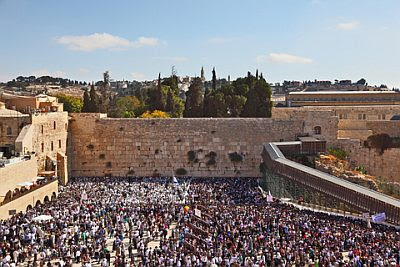
Crowds gather from around the world at the Western (Wailing) Wall during
the annual Jewish pilgrimages of Passover (Pesach), Pentecost (Shavuot),
and Tabernacles (Sukkot).

הַלְלוּ יָהּ

Halleluyah actually consists of two Hebrew words: hallelu, meaning praise (a plural imperative) and Yah (shortened form of Yahweh, the personal name for God and often written as LORD).

אָמֵן
Amen, a Hebrew word commonly said in prayer means dependable, faithful, certain and true.  This word has the connotation of faith, since its root A-M-N can mean faithful, have faith, believe, reliable, confirmed, and to be firm.
Amen is often translated as truly or verily in the Brit Chadashah (New Testament), which we will see later is quite Hebraic.
"In that day you will not question Me about anything.  Truly, truly, (amen, amen) I say to you, if you ask the Father for anything in My name, He will give it to you."  (John 16:23)
And, of course, people around the globe know the Hebrew word shalom, but not many know that it means much more than peace.  It encompasses wholeness, blessing, and well-being.  It is also used conversationally to greet others hello and goodbye.

The Hebrew word Shalom (read right to left).
The Miracle of Hebrew's Survival
Hebrew has against all odds defied extinction.
The fact that it’s now a modern language used daily by millions of people in Israel and in Jewish communities around the world is an absolute miracle.
Logically, Hebrew should have died out two millennia ago after Rome destroyed Jerusalem in AD 70 and defeated the Bar Kokhba revolt in 135, resulting in the scattering (Diaspora) of God's Chosen People to lands near and far.
In the Diaspora, the Jewish People acquired the local language for everyday use.  But Hebrew didn't completely fade away; it survived primarily in the synagogues and yeshivas (Jewish seminaries) as a scholarly and liturgical language.

The Great Synagogue on Dohány Street in Budapest, Hungary is the largest
synagogue in Europe and one of the largest in the world. It seats 3,000 people. 
While noticeable differences between Ancient and Modern Hebrew exist, they are not drastic.
In fact, if Moses were to return today, he would likely understand modern Hebrew, though he would have to learn some modern words as well as adjust to some differences in syntax (arrangement of words to form a sentence).
Some of these syntax changes are due to the influence of Yiddish, a combination of German, Hebrew, Slavic, and other European dialects that became the spoken vernacular of Ashkenazi Jews in central and eastern Europe beginning in the 9th century.
And, of course, many words had to be introduced to accommodate technical and cultural innovations.
Jewish man reads from a siddur (Jewish prayer book).
Eliezer Ben-Yehuda: Father of Modern Hebrew
Throughout the Tanakh (Old Testament), we see men of courage leading the Jewish People out of their exile and into their destiny.
God used Moses to bring the children of Israel out of slavery into freedom.  He used Joshua to bring them out of the wilderness into the Promised Land.  And He used Cyrus to bring them out of Babylon and even help them rebuild the Temple.
In the last two centuries, the movement of Jews back to the Biblical land of Israel required partners and visionaries in every area of nation-building.
In the area of language, God used a man named Eliezer Ben-Yehuda to help teach the Jewish People leaving the Diaspora how to speak Hebrew again in modern pre-state Israel, a nation that would be reborn as prophesied 2,700 years ago:
"Do not fear, for I am with you; I will bring your offspring from the east, and gather you from the west.  I will say to the north, 'Give them up!' and to the south, 'Do not hold them back.' Bring My sons from afar And My daughters from the ends of the earth."  (Isaiah 43:6)

Eliezer Ben-Yehuda
Ben-Yehuda, whose name means son of Judah, was born Eliezer Yitzhak
Perlman in Luzhki, located in the former Soviet territory and modern nation of Belarus.
He believed that the revival of the Hebrew language in the Land of Israel
could be the key to uniting the scattered Jews.  As such, he rejected the Diaspora lifestyle, including the speaking of Yiddish and other regional dialects.
Making aliyah (immigrating) to the Promised Land in 1881 at the age of 23, he set out to revive Hebrew as the native tongue for future generations of Jewish olim (immigrants).
History has proved his efforts successful.

Ben-Yehuda and his wife Hemda, 1912
Ben-Yehuda: Radical Approach to Reviving Hebrew
Eliezer Ben-Yehuda took a radical approach to his mission: some might even say fanatical!
He insisted that only Hebrew be spoken in his home.  He is even reported to have admonished his wife after hearing her sing a Russian lullaby to their child.  
The first native speaker of Modern Hebrew was his son, Ben-Zion (Zion's son), who also was only allowed to speak Hebrew. 
His extreme efforts paid off.  By setting an example in his own family and taking students into his home to learn Hebrew, along with the help of others passionate for the cause of national unity, he helped to start a linguistic revival.
  
Yarkon Park, Tel Aviv: In 1909, the first Hebrew city, Tel Aviv, was founded.
Hebrew so dominated the scene here by this time that one writer announced
in 1913:  "Yiddish is more treif (non-kosher) than pork. To speak it a person
needs great courage."
The Development of Modern Hebrew
Ben-Yehuda's deep calling and conviction caused him to push forward even amid accusations in the ultra-religious community that he and his work were blasphemous.
After two thousand years of isolated use, Hebrew had been viewed by Orthodox Jews as the one and only Holy Language, which should be spoken only during prayer and in the synagogue.
Through one of the newspapers that he edited, Ha-Zvi, Ben-Yehuda not only promoted his edgy Hebrew vernacular among the Land's religious residents, he waged war against certain religious practices and customs, which led to his arrest and the closing of the paper for fourteen months in 1894.  (National Library of Israel) 
The Orthodox community even declared Ben-Yehuda herem (excommunicated), but he did not waiver.  (My Jewish Learning)
In 1890, he established the Hebrew Language Committee (Va'ad ha-lashon ha-Ivrit).  The Committee set out to establish uniform standards in grammar, terminology, and pronunciation that would be used throughout schools, commerce, and government.
It published bulletins and dictionaries and established thousands of Hebrew words that are in everyday use today.  Ben-Yehuda’s English–Hebrew / Hebrew–English Dictionary is still one of the most commonly used dictionaries.

Ben-Yehuda at his desk working on his dictionary
Ben-Yehuda, who immigrated a year before the First Aliyah movement (1882–1903), saw the fruit of his efforts in the Second Aliyah (1904-1914).  In this movement, 35,000 olim (immigrants), mostly from Russia, entered the Ottoman-ruled land of pre-state Israel and many embraced Hebrew as their new spoken and written language.
In 1922, with the region now under control of the British Mandate of Palestine, Ben-Yehuda and his supporters crossed a great milestone—the formal declaration of Hebrew as one of the land's three official languages, alongside English and Arabic.
Sadly, near the end of that year, on December 16th, Ben-Yehuda died at age 64 of tuberculosis, a sickness he suffered from for most of his life.  
Such was the honor and respect that the Israeli people had for him that
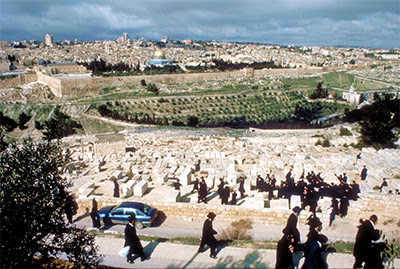
30,000 people attended his funeral.  He was buried on the Mount of Olives in Jerusalem.  

Nearly 150,000 cemetery plots line the western slope of the Mount of Olives,
facing the Temple Mount platform.  (Photo: Go Israel)
To honor Ben-Yehuda, large Israeli cities often have a street named after him.  In fact, the most famous and busy streets in both Jerusalem and Tel Aviv are named Ben Yehuda Street.
In the book Was Hebrew Ever a Dead Language?, Cecil Roth succinctly
summarized Ben-Yehuda's contribution this way:  "Before Ben-Yehuda, Jews didn't speak Hebrew; after him, they did."
Just five years after the Modern State of Israel was reborn in 1948, the
Israeli government replaced The Hebrew Language Committee with the
Academy of the Hebrew Language, which operates out of Hebrew University in Jerusalem.
The Academy continues to create new words from Hebrew root word structures as it replaces loaned words derived from other languages.
It also continues to set standards for Modern Hebrew grammar, orthography,
transliteration, and punctuation based on the historical development of the language.

Though it has been labeled Israel's "language police," the Academy considers its decisions binding only on formal speeches and written texts.  (Hebrew Academy)
Though Hebrew is now the native tongue of new generations of Israelis and integrated throughout society here, in the ultra-Orthodox religious neighborhood of Mea Shearim in Jerusalem, some still reject Hebrew and use Yiddish for their everyday spoken language.  
Even so, when they pay bills, deal with Israeli companies on the phone, and interact with the larger society, they do have to speak Hebrew.
The Mea Shearim neighborhood of Jerusalem
The Hebrew Bible
While Aramaic was for a time the common language of the Israeli people, including Yeshua (Jesus), it accounts for less than one percent of the Tanakh (Old Testament), which was written primarily in Hebrew.  
Out of the over 23,000 verses in the Tanakh, only 250 are written in Aramaic.  We find Aramaic, for example, in Ezra 4:8–6:18 and 7:12–26, Daniel 2:4b–7:28, and Jeremiah 10:11.
And although the Brit Chadashah (New Testament) is written primarily in Greek with some Aramaic, it is very Hebraic in nature.  Why?  The writers are Jewish, the culture is Jewish, the religion is Jewish, the traditions are Jewish, and the concepts are Jewish! 
The apostle Paul who wrote at least thirteen of the twenty-seven books of the Brit Chadashah even identified himself as being "circumcised on the eighth day, of the people of Israel, of the tribe of Benjamin, a Hebrew of Hebrews; as to the law, a Pharisee. "  (Pilippians 3:5)
Because of the strong Jewish identity of its writers, we find throughout the Brit Chadashah numerous references to the prophecies and practices of the Hebrew Scriptures.
For that reason alone, learning Hebrew helps us to better understand the true plans and purposes of God.
Roy Blizzard, Jr. in Understanding the Difficult Words of Jesus said,
“If any additional advances are to be made, especially in better
understanding the words of Jesus, the concentration must shift to the study of Hebrew history and culture, and above all, the Hebrew language.”
Believers who learn Hebrew today are doing far more than simply learning
another language; they are participating in a great end-time move of the Spirit of God, reconnecting the Church to its Jewish roots and revealing the true identity of HaMashiach (the Messiah)—Yeshua.
With your gift to this ministry, you are helping us develop the Free HEBREW Messianic Prophecy Bible Version that will be given to the Jewish People throughout Israel.
Moreover, we are developing free online software to help you and everyone around the world read the Messianic Prophecies and the whole Bible in Hebrew.
And hundreds of Bible Societies around the world will have our tools to translate the Hebrew Scriptures into their own languages.
"For I am ready to set things right, not in the distant future, but right now!  I am ready to save Jerusalem and show My glory to Israel."  (Isaiah 46:13)


If you wish to receive emails like this, please write to: news@biblesforisrael.com

Messianic Bible
Bibles For Israel
P.O. Box 8900
Pueblo, CO 81008

Sunday, April 12, 2020

THE POWER OF THIS YIQTOL VERB אֶהְיֶה


Three Lessons from the Burning Bush | One Year Challenge
Source of photograph: https://oneyearchallengeblog.org/2017/09/05/3-lessons-from-the-burning-bush/

THE POWER OF THIS YIQTOL VERB אֶהְיֶה


וַיֹּאמֶר אֱלֹהִים אֶל־מֹשֶׁה אֶהְיֶה אֲשֶׁר אֶהְיֶה וַיֹּאמֶר כֹּה תֹאמַר לִבְנֵי יִשְׂרָאֵל אֶהְיֶה שְׁלָחַנִי אֲלֵיכֶם׃

Exodus 3:14 God said to Moses, “I AM WHO I AM”; and He said, “Thus you shall say to the sons of Israel, ‘I AM has sent me to you.’”


In my earlier post, I mentioned that it is important for us to learn the Hebrew grammar if we want to do a proper exegesis of the Bible. 

Here, I give an example where I get a better insight into the Hebrew text: 

In the Hebrew text, we see God using the Yiqtol or Qal Imperfect verb אֶהְיֶה (pronounced as 'eiyeh' and often translated as 'I AM') to tell Moses who He is. He did not even use a proper noun or a Name as one would expect, but He simply told Moses about His existence.

There is a lot of insight packed into just this one word after you understand the grammar behind it.

*  *  *
First, allow me to explain: Hebrew tenses are not like English, which has past, present and future tenses to tells us the time of an action. Instead, in Hebrew, the emphasis is always on whether it is a Perfective or Imperfective Tense.

Imagine my father is reading the newspapers in the living room. If I take a video of him reading the newspapers, you will see the action of reading the newspaper as a continuous (on-going or imperfective) action. But if I captured his action of reading the newspaper and show it to you as a photograph, it will tell you this is a completed (or perfective) action.

Unlike the past, present and future tenses in English which gives us a sense of time when the action was, is or will be done, the perfective tense in Hebrew does not tell us when my father read the newspaper but that he completed the action of reading the newspaper. You don't see him doing it, or still doing it. It is a completed action. The photograph 'froze' his action.

In short, whereas the photograph tells you that he read (completed action) the newspapers, the video shows you that he is reading (continuous action) the newspapers. In Hebrew, we call the completed action as the Qatal verb; the continuous action is the Yiqtol verb.

*  *  *
Moving forward, we now look at the meaning of this one word, אֶהְיֶה


Meaning of 
אֶהְיֶה
The word אֶהְיֶה is a combination of two parts -- the pronominal prefix and the root word.

We know that this is a Yiqtol verb when אֶ is used as a pronominal prefix. The prefix אֶ tells us that the subject of the verb is the First Person Common Singular pronoun, or 'I', in short. God was referring to Himself as 'I' instead of 'We'.

I will now change the colour of the font for אֶ and put it in the background so that you can now see the root word (in purple) of the Yiqtol verb,  אֶהְיֶה.
  • Strong's Hebrew Dictionary defines the root word הָיָה hayah as a primitive root; meaning 'to exist', i.e. be or become, come to pass (always emphatic, and not a mere copula or auxiliary):—beacon, x altogether, be(-come), accomplished, committed, like), break, cause, come (to pass), do, faint, fall, + follow, happen, x have, last, pertain, quit (one-)self, require, x use.
  • אֶהְיֶה, being a Yiqtol (or imperfective) verb, we can now translate it in our own words, as: "I am in a continuous existence. I am not bound by time or space." This is why we see how this is sometimes translated elsewhere as, "I was, I am and I will be..."
This is a wonderful insight, indeed! It did not occur to me until last night.

Instead of just translating it as "I AM WHO I AM...," as though God was trying to tell Moses, in the same manner that we would tell people, "You just take me for who or what I am," now, I see God using the yiqtol (or imperfective) verb to describe Himself as being in a state of continuous existence.

Every created thing or being has a beginning, but here, the yiqtol verb tells us that it is not even correct to say that God was there 'right from the beginning'. With God, there is no 'beginning' but a continuous existence both before and beyond what we know as Time. In short, God told Moses that there are three dimensions to His existence:
  • He was already there before the beginning of Time or creation (eternity past);
  • He is also here (now and present);
  • He will be with us after the end of Time (eternity future)
His existence is from eternity past to eternity future!

This is a wonderful answer to people who ask, "Is there a God?" The next time this question is asked, I will refer to this verse and explain these three words, אֶהְיֶה אֲשֶׁר אֶהְיֶה .


-----------------------------------------------------------------------
Read why you need to spend time learning the proper Hebrew Grammar instead of just depending on some transliteration that you commit to memory without even understanding the way how the language works.


Saturday, January 30, 2021

WHY FORMAL HEBREW CLASSES USING A TEXT BOOK ARE IMPORTANT?


You have probably asked why formal Hebrew classes using a textbook are important? Why can't you learn Hebrew ad hoc? 


        If you look at the word that I have highlighted in the text, you will see it begins with the prefix 'ha'. Most of you would have thought of interpreting it immediately as 'the' (definite article) but how can it be 'the' when the word is a verb? You know that, even in English, you cannot put a definite article to a verb. The definite article is only in front of a noun but what if 'ha' is in front of or before (prefixed to) a verb? 

        If you look at the popped-up dictionary on Accordance Bible, it shows 'hifil imperfect'. After you have gone through the Hebrew classes, you will understand what is 'hifil imperfect'. 

Why Textbook?

        The beauty of doing it using a textbook is that, after you have forgotten what is the meaning  of hifil, you roughly know where to refer in the textbook. You won't be able to do this if you attend classes ad hoc here and there. Ad hoc classes will give you only very superficial understanding of Hebrew and it is superficial learning of Hebrew that leads to all the wrong interpretations of the Bible. You will have people saying Jehovah is 'the god of destruction' or even 'the name of the supremely evil.' This is all theological rubbish to me! 


        Now, see how I have scribbled it on Weingreen (textbook) and noted down that 'hifil' as 'causative'. 

        What is causative? It means an action caused by someone or something. For example, the king is `made great' by the Lord. You have the king on one hand and the Lord on the other hand. If the word 'gadol' (adjective,'great') is added a prefix 'hey' to become 'higdil' (a hifil), the word now suggests that it is the Lord who made the king great. 


        You will also learn that the word that I highlighted is a 'hifil imperfect.' When I refer to the table in Weingreen again, now it is beginning to sink in what I had learnt before. Hifil has the hiriq as the first nikud 'i' (hence, higdil) but when you change it a patach, you know it is imperfect. Imperfect means an action that has not been completed. In contrast to the perfect, the imperfect tells us that it is still ongoing, continuous and will be still happening in the future. 

You will see it and understand

        Yes, you won't see it now! But, trust me, if you are patient to go through the formal classes to learn the language proper, you will understand Hebrew so much better. 

        In this case, the word 'haskilu' is a hifil imperfect masculine plural which means 'to be wise, prudent, understand.' By this, once you have learnt the language proper, you will understand that it is causative (verb shows there is a cause/effect involved here), imperfect and the shuruk used as a suffix (attached to the end of the word) refers to masculine plural (a group of men). 

        Then, you will understand that this verb 'haskilu' refers to the kings. Kings are men and plural. Then, when you look at the context of the sentence, you will learn that the psalmist was urging the kings to (cause) show wisdom in their judgement. 

        You can therefore safely translate this part of the verse as '

        Cause all your judgements to be wise, O kings!" 

   or 'O kings, apply discernment to (or wisdom in) your judgements.' 

        The NASB translates it as 'Now, therefore, O kings, show discernment'. The English translation is static. That's why you are asked sometimes to refer to different English translations. That is the best you can do but you won't know what is the original text to be able to appreciate the meaning more. There is a lot more to the Hebrew used in the Old Testament.

        Once you know the text in the original language, you can give your own variety to the translation so long as it does not deviate from the rules that govern the language or out of the context of the verse.

        Other things that you will see when you read the Old Testament in its original language:


       (a) You will also learn that the name Absalom means 'father of peace.' When David named his Absalom, he had good intentions for him to be a father of peace. Instead, Absalom never lived up to his reputation. 

        (b) Look at this blogpost and you will understand why I say it is theological rubbish when I heard a video of a Westerner who taught that the hey added to Abram's name gave him a new zest of life. In the message I saw on video, this guy was basically introducing Eastern form of Transcendental Meditation when he told people to breathe in and breathe out the name YHWH. 

        Some local pastors are adopting this 'hey' and teaching in churches as a way to interpret Hebrew! Sadly, many are being misled as a result. As the Lord said in the last days, many false prophets and false Christs will arise and lead even the elect astray. We have to be extra cautious these days especially with the accessibility to all sorts of teachings on the Internet. We need to be properly equipped with the word of God to safeguard our faith. 


Wednesday, October 14, 2020

BLESSED BE THE LORD OUR GOD: IS HIS NAME JEHOVAH, YEHOVAH OR YAHWEH?


        In recent months, I have started to memorize Sriptures from the original Hebrew text and one of these verses is Isaiah 12:2. 

 הִנֵּה אֵל יְשׁוּעָתִי אֶבְטַח וְלֹא אֶפְחָד כִּי־עָזִּי וְזִמְרָת יָהּ יְהוָה וַיְהִי־לִי לִישׁוּעָה׃

        In the 80s, when I memorized this verse, the King James Version renders it as:

Behold, God is my salvation; I will trust, and not be afraid: for the LORD JEHOVAH is my strength and my song; He also is become my salvation.

        In the Hebrew text, the Name יָהּ (or Jah) and the tetragrammaton יְהוָה were  used simultaneously. 

        The tetragrammaton יְהוָה that we know and translated as LORD in our Bibles is based on the קְרֵי/  כְּתִיב tradition (i.e. the tetragrammaton is written as יְהוָה Jehovah/Yahweh, but read as אֲדֹנָי  Adonai).

        We must bear in mind that the Hebrew word   אֲדֹנָיis a majestic plural used only for the LORD God, which literally means, "My great Lord." See the definition given in sefaria:

אֲדֹנָי m.n. pl. the Lord, God. [Lit.: ‘my Lord’, the pl. of majesty of אָדוֹן (= Lord), with the suff. of the first person. The spelling with Qamatz serves to distinguish it from אֲדוֹנַי (= my lords).

        Someone asked, "What about יָהּ (or Jah)?" or the tetragrammaton יְהוָה ?"

        As mentioned in my earlier post, I think it does not matter whether יָהּ (or Jah) or the tetragrammaton יְהוָה but that we know who we are referring to. 

        The name has been translated as Jehovah, Yehwah, Yahweh by different scholars. Going by the Hebrew nikud, the closest transliteration that we can get is, in fact, Jehovah (with the J pronounced as a Y) or as some prefer to put it, Yehwah or Yehowah. The Mandarin Bibles also use this name. 

The Fallacy of 'Jehovah as God of wickedness'

       It is a serious matter of blasphemy against the Holy Name of God when there are people who claim that the name is the 'god of the supremely evil,' 'god of calamnity' or 'god of wickedness.' May our LORD have mercy on them.

       I have no intentions whatsoever to raise doubts about their teachings except to contend with these flawed teachings perpetuated by some people who claim to know Hebrew: 


        (1)  Edlin Abraham:

    
        This video clip is sufficient to caution us against such teachings. 

        (2) This same teaching is being perpetuated by another person Lily Khaw in her Zoom sessions. 

        I quote her verbatim: "Now, is Jehovah innocent, artificial, Latinised name? It is a harmless traditional hybrid name? Is that so?
        "This is one question I want you to take a look at it. Now, I want to tell you here, as the mouthpiece of God, I want to tell you, it is not! It is not innocent. It is not harmless. It is not merely a hybrid name. It is not. It has a deeper meaning to it." 
        Then, taking the illustration of backmasking of casette tapes (a method of playing the cassette backwards to surface a hidden message), she claims that the Name Jehovah may appear harmless on the surface, but it is "not so innocent." 
        She then claims that the name Jehovah is a combination of two words, quoting from Strong's Concordance: 
  • Yah (3050) = God
  • Hovah (1943) = ruin, calamnity, mischief, very wickedness


        My simple response: 
        I do not dispute the meaning of these two words. However, you cannot get pineapple by marrying a pine tree with an apple tree. In some cases, words are a hybrid of two individual words (like "appleseed" or even Abraham's name being  the "father of a multitude"), but not in this case the way she has made it up, then claiming that the Holy Name Jehovah is the "god of wickedness."  
         I quote her again verbatim: "If you combine the two words together, Yah-hovah or Jehovah, it is actually God of Wickedness." Any unsuspecting listener would have missed how she happily changes from Yah-hovah to Jehovah just to prove her point; there is, in fact, no basis for the swap of the a-vowel in Yah to the e-vowel-like in Jehovah as the tetragrammaton carries an e-vowel-like in the first syllable (יְהוָה).

        She then repeated this three times, identifying Jehovah as the 'God of Wickedness,' which I think is a serious blasphemy of the Holy Name of God.
      This is the folly of someone trying to combine two words that are totally unconnected and make the name Jehovah to "sound" like He is the "god of ruin, calamnity, mischief or wickedness."
        I find her explanation strange and too simplistic when she responded to a faculty member of hers who asked, "What about the name Yehowah in Chinese Bibles?" She replied (quoted verbatim), "Yeah, there is one scripture that is full of Jehovah. You know the 'New World Translation.' Straightaway, he said, 'Ah, that's a cult!' (referring to Jehovah's Witnesses)." 
        To such a point, my question is: "Do we not have the word Elohim in the Hebrew text that can refer to either the God of Israel, or even the gods of the Canaanites?" This does not mean that the Elohim who created the world is the same as the Canaanite gods. Having the same names does not mean that everyone with the name John Smith is the same John Smith that I know. Therefore, we cannot equate Jehovah of the Bible with the Jehovah of the Jehovah's witnesses. 

        
        Her reason for persuading people to drop the name Jehovah is because she claims that the sound you make carries the meaning "God of wickedness" or "God of ruin". This is simply a lack of understanding of the etymology of the tetragrammaton יהוה. 
        If sound is what she claims to be the same as 'god of wickedness' or 'god of ruin', there are words that have similar sound in different languages. Going by her rationale, for those of us who know Cantonese, shouldn't both Malachi and Haggai immediately drop their names, since these names pronounced in Cantonese sound like, "skinny chicken" and "black chicken," respectively? 
       To further illustrate my point, there is a word in Greek that is translated as 'I toil/ labour.' Now, if you go to the coffee shop and you shout out κοπιαω to tell everyone that you have been working very hard for the entire week, you will see a cup of kopi-o on your table. You just cannot equate a word from one language with word of another language. Words may sound alike, but they have totally different meanings. This is the fallacy of people who have been spreading rumours that the name Allah cannot be used just because there is a word in Hebrew אָלָ֔ה (Zech 5:3) that sounds the same, but meaning 'curse.' To these people, I said there is also a word in Greek αλλα which means 'but' and in Hebrew, we have a word in Genesis 1:1 בְרֵשִׁית which means 'beginning' and has nothing to do with the human or animal excretion. 
        Only those who have been brought up with the idea that the number four is a taboo for the Cantonese just because it sounds like "death" in Cantonese would come out with a theory that tries to relate God's Name as the 'god of destruction' or 'god of wickedness.' Why not suggest that all chapters four in the books of the Bible be changed to Chapters 3A just because four in Cantonese sounds almost the same as death.
        I wish to reiterate that our Heavenly Father, our LORD Jehovah is not the god of wickedness and to say that He is the god of wickedness, it is nothing but a blasphemy of the Name of God. 
        If she were correct in her interpretation, millions of believers at a time when the KJV used the Holy Name of Jehovah would now be in Hell. Far be it! To say that the Holy Name of Jehovah is the 'god of the supremely evil' or the 'god of wickedness' is nothing but a blasphemy. 

More Errors

        She quoted the work of Emil Gustav Hirsch, a major Reform Movement (Jewish) Rabbi in the US, that it was "grammatically impossible to transliterate 'Jehovah' from YHWH." My question is, "Why not?" 

        יְהוָה

       יְ - yә

       ה 

     וָה - vâ or wa

        According to Jewish biblical scholar, Nehemia Gordon, one of the actual pronunciation of the Name was intentionally hidden from the Gentiles. However, based on his research, Gordon found six Masoretic manuscripts where there were slip-ups in the copying process where the יהוה were copied with the full vowels for 'Jehovah' (fastforward the video below to 52:47 min). "The full vowels are never Yahweh," Gordon claims. Gordon reveals that he also found eleven rabbis who told him that the name is pronounced as Yehovah (listen to the video from 54:27 min onwards). 


        Now, for this lady to then claim that Jehovah is a mispronunciation caused by "Christian theologians," is simply irresponsible. 

        Her attempts to squeeze in the Hebrew vowels (or nikuds) from the word Adonai and Elohim into the tetragrammaton (יהוה) to give it a different קְרֵי/  כְּתִיב rendition to the same tetragrammaton is done to show why the name should not be pronounced as Yehovah or Jehovah.  


        There are also others who say that the Name Jehovah should not be used because it is used by the Jehovah Witnesses. This is ridiculous as the word Elohim is also used in the Bible to refer to the gods of the Canaanite. Does that mean we drop the Name Elohim from Genesis 1:1?

        Dr Bill Barrick in his lecture (watch from time 15:00 min - 30:00 min) explained very well about the Name Jehovah. He explains how although he prefers the name Yahweh, the Name Jehovah was formed using the vowels in Adonai to the tetragrammaton. I agree with him on this.


        In fact, Weingreen also explains it very well in his book, "A Practical Grammar for Classical Hebrew" (page 23). The name Jehovah or Yehovah, although impossible form of the tetragrammaton, is just a combination of the tetragrammaton with the vowels of Adonai. 
       
        Therefore, although I do not use the name or even Yahweh in my worship, whenever I sing the Scripture chorus, "Jehovah Jireh, My Provider" I have no problem using the name Jehovah. Just because the sound of the Name appears similar to something else, let us not bring God's Name to the point of blasphemy calling our God the god of wickedness. (Read until the end of this article and you will understand why).

Source: Weingreen, page 23


        My response: This clearly shows her lack of understanding of the Hebrew language and how it works:

        (A) It is more appropriate to say that a verb becomes a qal imperfect when the yod carries a segol as in the word יֶאֱהַב (meaning, 'he loves') in Prov 3:12. 
        (B) She has failed to convince me how the hiriq in Elohim makes the last syllable which is 'vih' or 'wih' to suddenly sound as 'him' (as in Elohim). Or, how qamats-hey in Adonai can become a qamats-hey. All except that this is a קְרֵי/  כְּתִיב rendition to the tetragrammaton; but everyone knows that in the standard Hebrew text words such as יֶהֹוִה simply do not exist!  
    Going a bit further, the name יְהוֹנָתָן (Yehonathan) means, 'God gives.' The first part of the name is, in fact, Yeho where the second syllable clearly carries the o-vowel. יְהוֹנָתָן (Yehonathan) is the Hebrew name for Jonathan in English/ German/Dutch/French/other European languages where the J is pronounced as a Y as in the case of Johann being pronounced as Yohann). The same with the name Jehozadak (יְהוֹצָדָק) and Jehozabad (יְהוֹזָבָד). If Yeho (or Jeho) can be accepted as 'God', there is no reason why the tetragrammaton cannot be read with the missing 'o-vowel' to it as Yehovah or Jehovah.                   

    The  קְרֵי/  כְּתִיב tradition simply means that whenever the Name Jehovah appears in the Scriptures, the Jews would read it as Adonai (Weingreen, 22). In my post here, I pointed out that all things Jewish may not necessarily be correct as the tetragrammaton can be prefixed with some inseparable prepositions! Wouldn't this be something unthinkable for the Jewish mindset but words such as לַיהוָה  appears 580 times through the entire Old Testament).

        At best, this is just her attempt to prove that the name Jehovah is not correct and to then conveniently link it to the 'god of destruction' or 'god of wickedness.'  
      
       Finally, I encourage us to watch this video by Jeff Benner which explains that the Name of God should not cause any unnecessary division in the church, especially when someone claims that the Name which has been used in the Bibles for centuries is, as both persons claim, the 'god of wickeness' and the 'god of the supremely evil.' This is divisive as it touches on the sensitivity of people who have been worshipping God and have identified Him as Jehovah Jireh, Jehovah Rapha, and so on. Millions of people have also been singing the Scripture choruses, "Jehovah Jireh, my Provider..." 


        While having my devotion, I stumbled upon Psalm 40: 5 which appears to have all the Nikud. This could possibly be due to the scribe who copied the manuscript: 


        In my discussion with this lady, I noticed that she is fond of saying, "God spoke to me." The danger of this is, of course, when two persons of opposing views come together and say that God revealed to them something. Which God is the right God or whom has God really spoken to? 

        It is okay for anyone who feels that he/she does not want to use the Name Jehovah, but to call Jehovah the God of Wickedness or the Name of the Supremely Evil is to blaspheme the Name of the LORD. 

        I pray for God's mercy upon all of us that such heresies will not spread and the blasphemies will not be uttered against the Name of our LORD God Jehovah, who alone is the אֶהְיֶה אֲשֶׁר אֶהְיֶה (I AM WHO I AM). Amen. 


Read further another blogpost.. 


The Link between the Lord's Supper and the Passover feast, as explained by Amir Tsafarti

  This is one of the best explanations of the Passover feast I’ve heard—from a Messianic Jew and true brother in Christ!           Amir’s te...